Saturday, 15 January 2011

Steve has plenty of bottle

At our club meeting on Wednesday we were treated to a fascinating talk by Steve Homewood, an expert on bottles. He started in 2000 when he lived in Lewes and the river flooded. Bottles were flushed and dumped by the flood and Steve investigated and began his passion. He was based in Brighton for some time and has found and collected bottles from all over Sussex, including some unique and rare examples.
He now lives on the Isle of Bute, and commutes regularly to Brighton, so his finds now include Scottish bottles.
His site is www.brightonbottles.com

Steve’s books can be bought direct from Blurb. His latest book 'Bottle digging Adventures' should be available in April.

These are some of the bottles he showed us.


pipes 
plate from a row boat


poor photo but interesting ointment! 
Cups of tea were handed to soldiers on a train passing through Selby station and were left at the next station to be returned.

Monday, 10 January 2011

Artefacts and strong winds

It’s been a busy few days. On Saturday I attended an afternoon PAS Recorders Conference at Maidstone County Hall. FLO’s from several counties attended and the main aim was to introduce detectorists and artefact finders to the PAS database so they can enter their finds online. It was well organised and an excellent manual provided which is also available online. Various speakers gave interesting talks, including Helen Geake, National Finds Advisor for Early Medieval to Post Medieval periods. I immediately recognised her from Time Team which she appears on regularly. Her presentation slides are available online.

On Sunday we had a club dig near Shoreham. It was a cold windy day with bursts of warm sunshine so my scarf and hat came on and off regularly. The sky was clear, and it was good to be out all day. There were many finds from this site where I found my first Roman coin previously. Mike found this Scottish penny, Alexander III (AD 1249-1286):
Reverse: Long cross. Obverse: Crowned head left, with sceptre, inscription: ALEXANDER DEI GRA. A similar coin is on the PAS database.

Cut quarters and halves were also found.
My finds were

a 13/14th century annular brooch, 2.92g, 16.16mm diameter
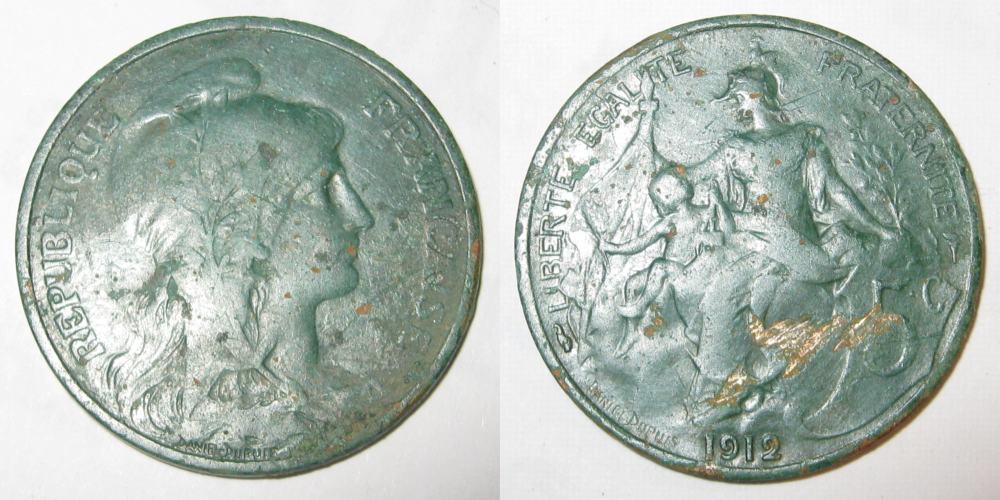
a French 5 centime dated 1912. As it was about the same size as a halfpenny I guess it was used as one. It has a nice green patina and weighs 4.72g, 25.24mm diameter
a General Service military uniform button, 5g, 24.11mm diameter, 7.19mm deep
A lot of rifle cartridges and mortar shrapnel, mainly tail fins, were found so the area was a training ground during the last war. I also found a plain tombac button, a small spoon handle and separately the bowl of a sugar spoon.
Today we did our walk along the seafront to the pier. There was an extremely cold southerly wind, foam on the beach and the River Arun was as high as we have ever seen it. The sea had two metre swells before breaking on the beach.

the waves were coming up river to the level of the wooden walls

sea foam on the beach

Monday, 3 January 2011

Excellent attendance and a silver green man

Yesterday morning we had a club dig near Ashurst on pasture on a cold, dry day.

It warmed up later
Six of us turned out and we quickly determined that the fields were pretty noiseless. Rifle cartridges and mortars showed up and Gill found a nice buckle.
I found two interesting items. The first was a school attendance medal. 
before cleaning
after cleaning
I found this identical medal on ebay showing the pin used to attach the medal
note: I revised this post on Jan 4 after using ultrasound and brushing to clean the medal.
On one side is a shield containing six Martlets with 'WEST SUSSEX EDUCATION COMMITTEE’ round the edge, on the other side the words ‘AWARDED FOR ONE YEARS  EXCELLENT ATTENDANCE AT SCHOOL’ Martlets were stylised birds without feet, based on the house martin. The Sussex Shield before 1889 consisted of six martlets. After that date the two administrative counties East and West Sussex were created each with its own coat of arms. So the medal was produced after 1889.
The medal weighs 28g, with 40.7mm diameter and 3.45mm thickness.

Sue gave me a short story by Saki (1870-1916) in which a child's good conduct medals play a central part. It can be read here: The Story Teller'.
This is a link to a family site with photos of Good Conduct medals for around 1908-10.
 
The other item was found near the gate just before I packed up. It is a silver green man. On the reverse are the marks for Birmingham (anchor), Sterling silver (lion) and date letter ‘a’ in the shape for 2000. In the middle is a solder mark where it was attached to something.
 The green man weighed 6.23g and 27.7mm diameter